

International Economic relationship
Mahsulot tavsifi
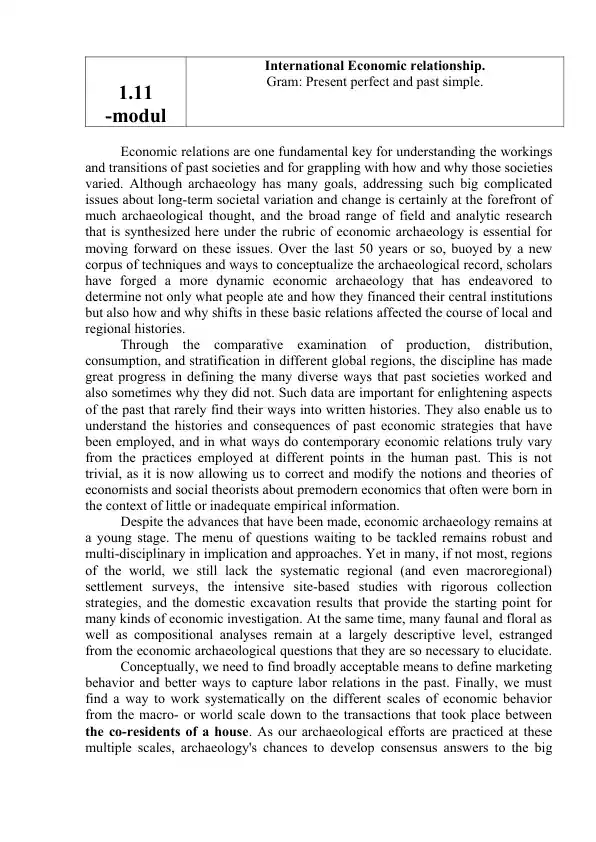
Economic relations are one fundamental key for understanding the workings and transitions of past societies and for grappling with how and why those societies varied. Although archaeology has many goals, addressing such big complicated issues about long-term societal variation and change is certainly at the forefront of much archaeological thought, and the broad range of field and analytic research that is synthesized here under the rubric of economic archaeology is essential for moving forward on these issues. Over the last 50 years or so, buoyed by a new corpus of techniques and ways to conceptualize the archaeological record, scholars have forged a more dynamic economic archaeology that has endeavored to determine not only what people ate and how they financed their central institutions but also how and why shifts in these basic relations affected the course of local and regional histories. Through the comparative examination of production, distribution, consumption, and stratification in different global regions, the discipline has made great progress in defining the many diverse ways that past societies worked and also sometimes why they did not. Such data are important for enlightening aspects of the past that rarely find their ways into written histories. They also enable us to understand the histories and consequences of past economic stra
Teglar
International Economic relationship

Muallif
Islam UZB
Tasdiqlangan sotuvchi